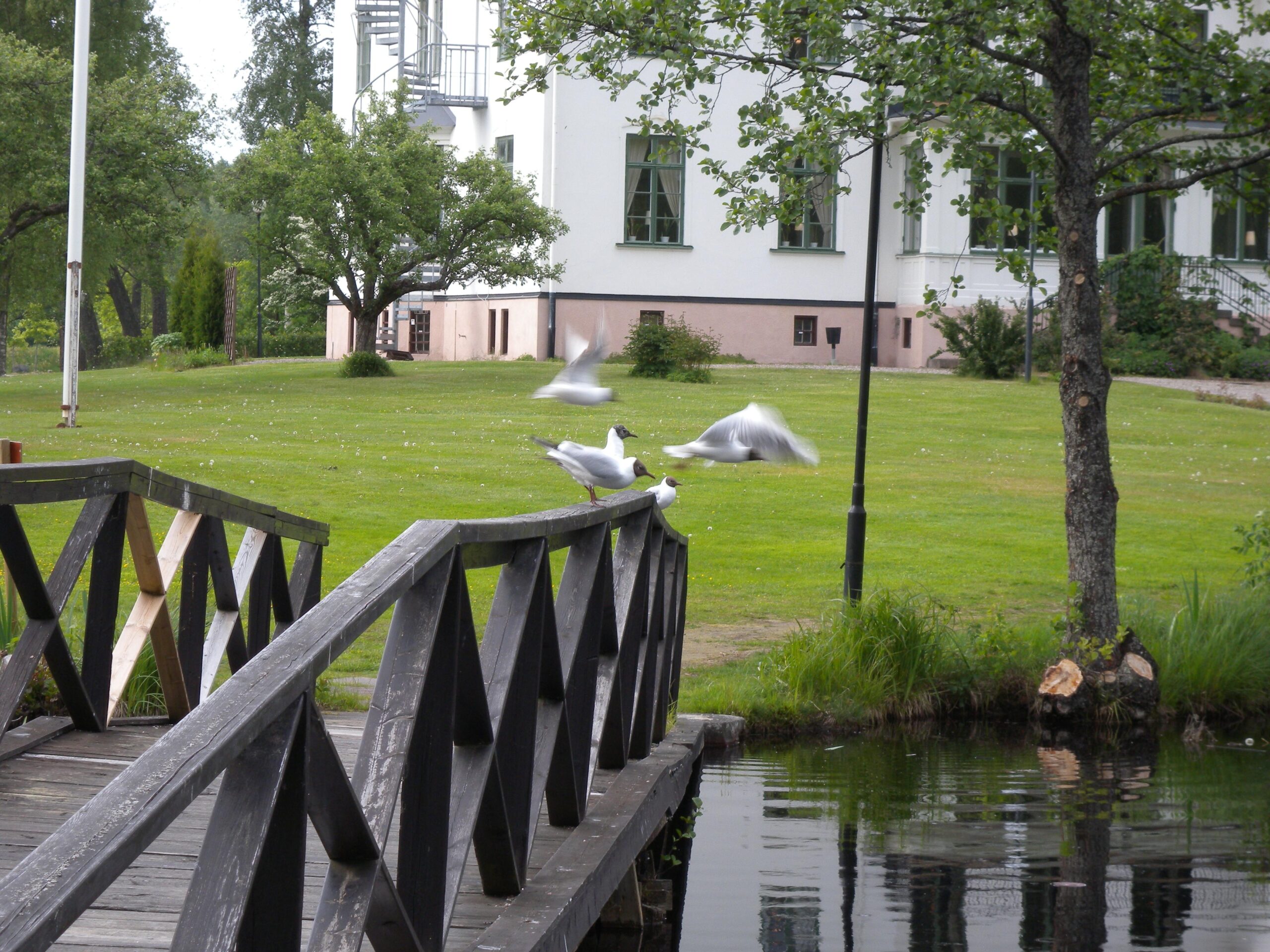
The ruins of Hovgården on Adelsö are quite extensive – this was the royal seat while the city was on the nearby island of Björkö.


The ruins of Hovgården on Adelsö are quite extensive – this was the royal seat while the city was on the nearby island of Björkö.


The ferry over to Lilla Stenby crosses while the lake around is frozen.


[Read aloud to Adelle]
Beyond Siberia by Christina Dodwell
I found this book in large print lurking in a National Trust second hand bookshop, and I have yet to find a way to resist travel books, especially when they involve tundra.
As a book published in 1993 this offers a window into a parochial world distant in both time and space.
Dodwell took the opportunity shortly after the dissolution of the Soviet Union to travel to the farthest reaches, the Kamchatka peninsula. An area crude even by the standards of the rest of Russia at the time.
She spends some time with a dance troupe entertaining some of the local tribes, visits a nature reserve and joins some reindeer herders for their springtime. Immersing herself in the local life for three months she documents a lot of what she sees and the people she meets.
It was not common for there to be visitors from outside the area at that time, never mind from another country, but it seems like everyone was welcoming and happy to share their experiences with her.
She was game for all kinds of immersion, driving reindeer sleds and eating blood soup and riding vezdekhod (water tanks for in Russia) and hunting mammoth bones, and describes some of those experiences in gory detail.
My wanderlust is not so strong with the subject matter, it all seems rather primitive and I’m pretty sure I would have baulked at the food. This is why I like reading about these things that other people have done, I can find out about places I have no way or desire to visit myself.
The writing style is a more like a diary that has been edited rather than an actual book being written. This gives it a charm of following the lives of her companions, while making it feel a little incoherent.
Further north west on the island of Ekerö is the village of Munsö, with a round church.


Upplands 19: “Frösten reste denna sten efter Hadske sin fader”
“Frösten raised this stone after Hadske, his father”


Asknäs is a small village on the island of Ekerö.


Outside the town of Ekerö is a small palace.


Beyond Drottningholm is the town of Ekerö, near the bridge onto the island of the same name.


Some time ago I tried to write about what I thought was wrong with fiction. Reading the The Science of Storytelling has given me some more insight into that, so I’m going to try again, with a little more knowledge.
There are a few parts to it, mostly I think it comes down to there being too much fiction in the fiction. Long form fiction tends to suffer more, a television show or book series that keeps going beyond its logical conclusion, where they have to keep introducing changes of allegiance to keep the drama going. They keep trying to surprise you by making people who previously hated each other have to work together.
It is okay for characters, and their interactions with each other, to change over the course of a story, indeed, without that there probably isn’t much of a story. Most people don’t change dramatically, even when going through some of the traumas they get subjected to by writers, its more likely existing traits crystallise. They may encounter internal conflict, a cognitive dissonance, when their existing characteristics do not serve them well, but changing is a long game, not something for a page or two.
The things that can change are how people see other people, but this often requires somebody to be hiding a significant trauma that made them what they are when we meet them in the story, only to reveal that secret at an opportune moment to move the story along.
Shorter stories, those of only film or book length, still feel they have to have a crescendo to the action, and a lot of them jump through unbelievable narrative hoops to get to that climax, as if they were trying to find a way to get to that important scene. Like the scene came first in the writing and they worked backwards from there.
So it seems to me that most fiction is created upside down, driven by working back from the conclusion and filling in the signposts on the way, rather than actually being made of a story in need of telling.
I have long felt that films are too long, I would much prefer to watch a film of 70 minutes that was full of story than one of 140 minutes where that story had been stretched to fill the time.
There are some types of stories that lend themselves to being told, especially detective stories, because they can be built around an asymmetry of information, our minds like to see the asymmetry resolved and will hold on to otherwise terrible stories to get that resolution. There are many more murders in fiction than in reality (or, at least, I hope there are), leading to a warped perception of the safety of certain areas.
Time travel stories are another genre that allow creative freedom from the shackles of reality – though a good, temporally accurate, story can be told with travel through time as asides or memories, without a need to strain the laws of physics.
Non-fiction books rarely fall into these traps as they are recounting real events happening to real people. This is where books about travel really hit the mark for me, there is action and the change over time of the character, typically the writer, but without the artificial narrative arc that forces the desired conclusion.
Of course, I’m no writer, nor critic, so I’m not well placed to discuss these things, I have little to add to what has already been said by those better able to say it. I am understanding these things for my own personal enlightenment, to help me find more of the stories I like, and to understand why I dislike those I dislike.

[Audiobook]
The Science of Storytelling by Will Storr
I have, for a while, been interested in the process of the generation of fictional stories. My interested was piqued by a screenwriting session at Em-fest before Christmas and I wanted to find out more.
Also, for a long time, I have been thinking that fiction is flawed, and I wanted to understand why I thought that. Now I do.
The book starts out being a bit of a showing off about how many books the author has read, giving a lot of examples of the first few sentences of books. After a while, though, it settles down into some actual content about the importance of stories in the historical context, how and why they developed, and what makes stories interesting. The first sentences are important, they are the reason you want to read the rest of the book, they pose a question in your mind, one which you must find out more about, even if it is not answered by the rest of the book.
There is a slant toward fiction but the techniques here would apply just as well to telling of true stories, perhaps even better, since there is no need for the invention of plot devices to keep the story together, the history is the plot device. It becomes, instead, a question of picking the starting and ending points, and drawing the arc between them.
Some of the neuroscience is covered and some communications theory, with explanations of how to paint vivid pictures in the readers mind, how to communicate what you are thinking to someone else’s brain.
The development and change of characters takes a lot of coverage, with the background of characters being important to how they are changed by their challenges through your story.
The book ends with a recipe for generating characters whole enough they can be easily written about, he calls this the ‘sacred flaw’ approach, which can be summarised – your character has some characteristic core to their being which hinders them in their travails during the story and the story challenges this flaw. The real story is about how they change in response to these challenges.
All in all, a good book about how to write stories, worthy of a second listen. I will come back to it in six months or a year.