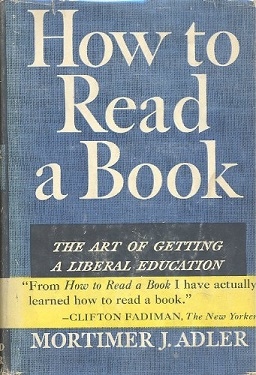
[1972 edition, audiobook]
How to Read a Book by Mortimer J Adler is the work of a heretic. But I’ll come back to that later.
There are a number of levels of reading described by this book, elemental reading that most of us learn at school, through to syntopical reading, a skill for obtaining wisdom from the reading of multiple books at the same time. Most of the book concerns itself with analytical reading, during which he suggests you ask yourself a number of questions:
- What is this book about?
- Is it true?
- What of it?
In order to prepare yourself to answer these questions, you need to make some notes. This is where the heresy comes in, the notes should be made in the book itself. Either inside the cover sheets, or in the margins near the point they are highlighting. These notes should be personal, they are your understanding and for you to come back and understand again later. Marginalia.
He suggests there should be several phases to reading, an initial structural stage, where you get the feel of the book, reading the table of contents and skimming through the chapters. Then an interpretive stage during which you read and make notes on anything that seems important. Finally followed by a critical stage where you critique the book based on your notes and are elevated to the level of understanding of the writer.
There are some specific suggestions for various types of books, scientific books often lend themselves to this depth of reading while poetry much less so, though you can perform some mental gymnastics to interpret poems in this way.
I am currently reading Noise by Daniel Kahneman which is a scientific book written with this kind of reading style in mind – each chapter has a brief explanation before and a few important quotes after, removing the need for most people to make their own marginalia.
Finally there is a list of significant works that would yield to the suggested approaches to reading them.
While I have rarely seen this kind of reading in the wild, Piercarlo being a glaring exception walking the line between making notes and not marking the books by extensive use of post-it notes, I can understand that it would be a great way to get good information out of a book. You don’t see books with these kinds of notes in the second hand market because the notes are so personal, they have no meaning and a negative value to anyone else, making the book spoiled not augmented.
There are very few books I can think of that warrant this depth of attention, especially now that it is so much easier to write and publish books than it was when this guidance was written, but also because I feel I get more from a new book than I do from spending more time with one I know now. A second reading often yields much detail missed on the first, but to spend the time making notes in this way a book would have to be groundbreaking.