[Audiobook]
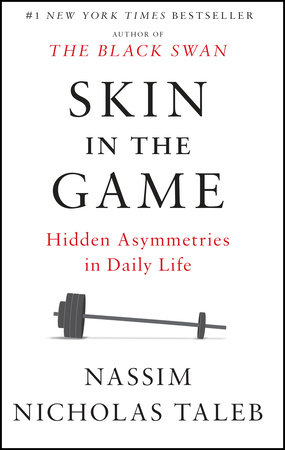
Skin in the Game, Hidden Asymmetries in Everyday Life, is a book about the meaning and value of risk taking. The main premise being that for risk taking to have any value there must be some downside for the risk taker. If you have no Skin in the Game, you have no place to be rewarded for the risks you are not taking.
A lot of his worldview comes from his origin as a trader where he learned how to understand and tame risk for his own use, where he also rebelled against the risk controls enforced by his trading masters which held back his ability to put his all into his trades for them.
He covers a lot of examples from the worlds of business and politics, and expresses a particular disdain for career academics, those who have experienced the real world and returned to academia get more of his respect.
One observation he makes is the distinction between risks when seen from an individual and a population point of view, especially where there is risk of ruin for individuals. Populations can benefit from such risks even if they are not rational for individuals. This has parallels with the medical world, where doctors and patients have very different views of those risks and the payoffs from them. I am still trying to find a good exploration of this distinction in the medical realm – I have some ideas in my head of the distinction, but cannot articulate them fluently. I have also seen translation of some of these population disease dynamics ideas into understanding error prevalence in an installed base of embedded systems, but again lack any kind of research to back those ideas up.
While I have read previous books by Taleb, Fooled by Randomness and Black Swan, I picked up on more political opinion in this than his previous works. That opinion sometimes sits uncomfortably with me – I understand he’s got a point to make and it backs that up, but he veers further into libertarian and laissez faire territory than I would like.
There is a kind of breathless self-importance to the voicing (of this audiobook) which verges rather too far toward arrogance given some of the content and its criticism of the works of ‘lesser minds’. The reading itself is clear and accent easy enough to listen to, and would come over better with other, less pompous, material.
The book is a collection of books arranged over a weird collection of chapters – this might make more sense in the printed version but adds a layer of confusion in the audio version.
Pingback: Book review review | Neil Hopcroft